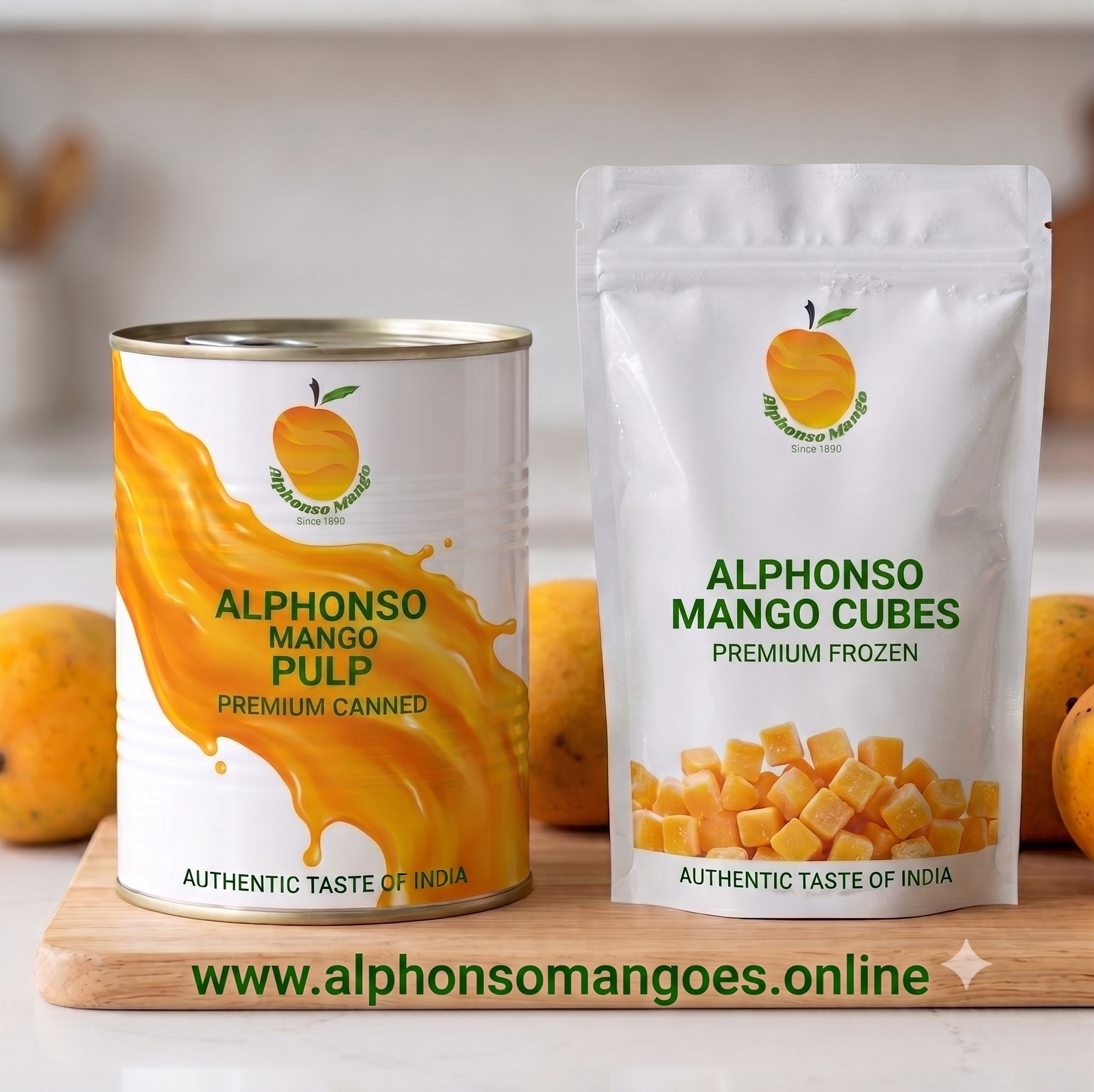
Buy Alphonso Mango Pulp:Canned vs. Frozen
Which Retains the Authentic Taste?
Alphonso mangoes—famously known as Hapus—hold an unchallenged position as the king of tropical fruits. Celebrated globally for their luscious, saffron-hued flesh, rich aroma, and melt-in-your-mouth texture, fresh Alphonsos are unfortunately available for only a short season every year, typically from April to June.
For culinary enthusiasts, commercial bakers, and global Indian diaspora longing for that authentic coastal Konkan flavour year-round, purchasing processed Alphonso mango pulp online is the standard solution.
However, when browsing options online, buyers face a primary dilemma: Should you choose canned or frozen Alphonso mango pulp?
While both formats make the fruit accessible throughout the year, the method used to preserve the pulp drastically alters its flavour profile, aromatic intensity, colour, and nutritional integrity.
This guide provides an in-depth comparison of canned versus frozen Alphonso pulp, helping you decide which processing method delivers the true, uncompromised Hapus experience to your table.
What Makes Alphonso Mango Pulp Special?
Originating primarily along the GI-tagged Konkan coastline of Maharashtra (specifically regions like Ratnagiri, Devgad, and Sindhudurg), the true Alphonso mango possesses a complex chemical and sensory footprint that sets it apart from all other cultivars:
-
Complex Terpene Profile: Alphonso mangoes derive their signature perfume-like aroma from volatile compounds (primarily monoterpenes like cis-ocimene and myrcene, alongside lactones). This aroma hits your senses before the fruit even touches your palate.
-
Optimal Brix-to-Acid Ratio: The sugar content (Brix level) of a fully ripe Alphonso sits around $18^\circ$ to $22^\circ \text{ Brix}$, balanced naturally by a gentle citric acidity ($0.2\% – 0.4\%$). This prevents the pulp from tasting cloying or flatly sweet.
-
Silky, Fiberless Flesh: Unlike fibrous varieties, Alphonso flesh consists of short, delicate structural fibers, giving it a ultra-smooth, buttery viscosity.
-
Vibrant Carotenoids: High levels of $\beta$-carotene give the pulp its characteristic deep saffron-golden hue.
When converting fresh Alphonso fruit into packaged pulp, the primary objective of any preservation method is to keep these volatile compounds, delicate pigments, and natural sugars as intact as possible.
1. Canned Alphonso Mango Pulp: Mechanism, Pros & Cons
How Canned Pulp is Processed
Canned Alphonso pulp relies on traditional heat preservation techniques—specifically thermal sterilization or aseptic processing followed by hot filling.
-
Extraction & Standardization: Fresh Alphonso mangoes are washed, destoned, pulped, and passed through dynamic sieves (mesh screens) to ensure uniform consistency. Sugar syrup or acidity regulators (like citric acid) are frequently added to standardize batch-to-batch variations.
-
Thermal Treatment: The pulp is passed through a tubular heat exchanger, heated to temperatures ranging between $90^\circ\text{C}$ and $105^\circ\text{C}$ ($194^\circ\text{F} – 221^\circ\text{F}$) for several minutes to pasteurize the product, destroying spoilage micro-organisms and deactivating indigenous enzymes like polyphenol oxidase (PPO).
-
Canning & Sealing: The hot pulp is filled into lacquered tin cans, sealed hermetically, and cooled rapidly to create a vacuum seal.
[Fresh Mangoes] ➔ [Washing & De-stoning] ➔ [Sieving/Pulping] ➔ [High-Heat Pasteurization (90-105°C)] ➔ [Hot Canning & Hermetic Sealing] Thermal Processing Effects on Flavour
While thermal canning guarantees commercial sterility and extended shelf stability at ambient room temperatures, heat is the natural enemy of fresh Alphonso volatile aromatics.
High-temperature exposure triggers two distinct chemical reactions inside the pulp:
-
Maillard Reaction & Caramelization: Thermal energy causes natural fruit reducing sugars (fructose and glucose) to react with amino acids, creating slight caramel-like notes and subtly darkening the pulp from vibrant saffron yellow to a deeper amber or brownish-orange.
-
Volatile Loss: Thermal processing strips away delicate monoterpenes and lactones through evaporation and heat degradation. As a result, canned pulp tastes noticeably “cooked” or jam-like rather than fresh.
Advantages of Canned Pulp
-
Ambient Storage: Requires zero refrigeration until opened, drastically reducing logistical costs.
-
Extended Shelf Life: Unopened cans remain shelf-stable for 18 to 24 months.
-
Commercial Consistency: Highly reliable consistency, sugar density, and viscosity, making it an industry standard for commercial confectionery, dairy, and large-scale catering.
Disadvantages of Canned Pulp
-
Prominent “cooked” or processed taste profile.
-
Diminished volatile aroma upon opening.
-
Frequently contains added sucrose ($2\% – 5\%$) or citric acid to meet safety and shelf-life standards.
2. Frozen Alphonso Mango Pulp: Mechanism, Pros & Cons
How Frozen Pulp is Processed
Frozen Alphonso pulp prioritizes thermal avoidance, utilizing sub-zero temperatures to achieve stabilization rather than extreme thermal destruction.
-
Extraction & Gentle Deaeration: Ripe mangoes are washed, peeled, and pulped under controlled sanitary conditions. The pulp passes through vacuum deaerators to remove incorporated air bubbles, preventing oxidative browning.
-
Flash Freezing / IQF Processing: The raw pulp is conditioned, placed in food-grade barrier pouches or tubs, and rapidly frozen using blast freezers or plate freezers to temperatures at or below $-18^\circ\text{C}$ ( $0^\circ\text{F}$ ).
-
Cold Chain Logistics: The frozen product is continuously maintained within an uninterrupted cold storage chain throughout distribution.
[Fresh Mangoes] ➔ [Washing & De-stoning] ➔ [Sieving] ➔ [Vacuum Deaeration] ➔ [Blast Freezing (-18°C)] ➔ [Cold Chain Distribution] Cold Preservation Effects on Flavour
Because frozen pulp undergoes minimal to no thermal processing, the delicate chemical compounds responsible for the true Alphonso signature remain largely unchanged:
-
Preserved Aroma (Terpenes): Volatile aromatic compounds remain locked within the frozen matrix. Upon thawing, the pulp releases an aroma virtually indistinguishable from a freshly sliced Alphonso mango.
-
Unaltered Color & Pigment: $\beta$-carotene pigments are protected from thermal oxidation, retaining a bright, glowing golden-yellow hue.
-
Natural Viscosity: Lacking heat-induced starch gelatinization, frozen pulp maintains the natural, velvety mouthfeel of fresh mango puree.
Advantages of Frozen Pulp
-
Authentic “Fresh Fruit” Taste: Closest available profile to a naturally matured, freshly picked Konkan Alphonso.
-
Clean Label Potential: Often processed with zero added sugar, artificial preservatives, or acidity regulators (100% pure mango pulp).
-
Superior Aromatic Intensity: Retains high levels of native volatile organic compounds.
Disadvantages of Frozen Pulp
-
Cold Chain Dependency: Requires strict freezer storage at or below $-18^\circ\text{C}$. If the cold chain breaks during transit or storage, quality degrades rapidly.
-
Prep Time: Requires controlled thawing before use.
-
Higher Logistics Cost: Frozen freight increases shipping fees, making frozen pulp generally more expensive online than canned alternatives.
Comprehensive Sensory & Technical Comparison
To clearly evaluate which preservation method fits your specific culinary needs, consider this direct comparison:
| Attribute / Feature | Canned Alphonso Mango Pulp | Frozen Alphonso Mango Pulp |
| Primary Preservation Method | High-Heat Thermal Sterilization | Sub-Zero Rapid Freezing ($-18^\circ\text{C}$) |
| Aroma Profile | Moderate; slightly muted or jammy | Excellent; bright, fresh, high-terpene notes |
| Flavour Characteristics | Rich, sweet, slightly “cooked” / caramelized | Raw, naturally sweet-tart, authentic Hapus profile |
| Visual Color | Deep amber to dark orange | Bright, glowing saffron-yellow |
| Mouthfeel / Texture | Dense, gelatinous, or heavy | Creamy, silky, identical to fresh fruit puree |
| Added Ingredients | Often contains $2\% – 5\%$ added sugar & citric acid | Typically 100% pure mango pulp (no additives) |
| Unopened Shelf Life | 18–24 months at room temperature | 12–18 months at $-18^\circ\text{C}$ |
| Storage Requirement | Ambient dry pantry | Dedicated freezer space required |
| Best Used For | Baked goods, long-simmered sauces, commercial fillings | Aamras, smoothies, sorbets, gourmet desserts, raw toppings |
Culinary Applications: Matching Pulp Type to Usage
The decision between canned and frozen Alphonso pulp isn’t purely a matter of quality—it also depends on how you plan to use the pulp in your kitchen.
┌── Baked Goods / Cakes ├── Simmered Sauces / Marinades Canned Pulp ──────┼── Ice Cream Bases (Cooked Custards) └── Commercial Bulk Catering ┌── Fresh Aamras ├── Smoothies, Lassis & Shakes Frozen Pulp ──────┼── Raw Sorbets & Gelatos └── Artisanal Dessert Toppings / Mousse When Canned Pulp Works Best
If your recipe involves high-heat cooking, thermal processing, or heavy blending with other dominant ingredients, the thermal loss in canned pulp becomes far less noticeable.
-
Mango Cakes, Muffins, & Bread: The heat of baking will alter delicate raw aromas anyway, making canned pulp a cost-effective, high-performing choice.
-
Cooked Mango Curries & Sauces: Dishes like Mango Kadhi, sweet mango chutneys, or glazing sauces benefit from the deeper, caramelized notes of canned pulp.
-
Bulk Catering & Commercial Manufacturing: High convenience, easy storage, and lower cost per kilogram make canned pulp ideal for large-scale production where freezer space is limited.
When Frozen Pulp Is Unmatched
When the mango pulp is the star of the dish and consumed raw or minimally processed, frozen pulp is unequivocally superior.
-
Authentic Aamras: The classic West Indian dish (Aamras) relies entirely on raw mango flavour and fresh aromatics. Frozen pulp thaws into an authentic Aamras that canned variants cannot replicate.
-
Gourmet Sorbets, Gelatos, & Mousse: For uncooked frozen desserts, raw mousses, or delicate pastries, frozen pulp delivers the vibrant color and bright, authentic acidity of freshly picked fruit.
-
Lassis, Smoothies, & Cocktails: Blending thawed frozen pulp with yogurt, milk, or spirits yields a refreshing, naturally aromatic drink with no artificial or “cooked” undertones.
5 Buyer Guidelines when Purchasing Alphonso Pulp Online
Regardless of whether you choose canned or frozen pulp, manufacturing quality varies widely across brands. Ensure you evaluate these five critical factors before adding pulp to your online cart:
1. Verify Geographical Origin (GI Status)
True Alphonso mangoes gain their world-renowned flavour from the distinct microclimate and laterite soil of coastal Maharashtra (Ratnagiri, Devgad, Sindhudurg, Raigad). Always check product labeling for origin details. Pulp labeled simply as “Indian Mango Pulp” or sourced from non-coastal inland regions may use cheaper, less aromatic mango cultivars blended with Alphonso.
2. Inspect the Ingredients Label
Check the ingredient list carefully:
-
Ideal (Frozen): 100% Alphonso Mango Pulp.
-
Acceptable (Canned): Alphonso Mango Pulp (95%+), Sugar / Sugar Syrup, Citric Acid (INS 330).
-
Red Flags: Added synthetic food colours (such as Tartrazine or Sunset Yellow FCF), artificial flavouring agents, or high levels of high-fructose corn syrup (HFCS). High-quality Alphonso pulp requires zero added colors or artificial flavors.
3. Check Sugar Content Brix level
-
Natural ripe Alphonso pulp naturally measures between 18-22 deg brix
-
If a canned or frozen product lists brix 24 deg or higher without explicit indication, heavy sugar syrup has likely been added, which alters the natural balance of sweetness and acidity.
4. Evaluate Packaging & Cold Chain Integrity
-
For canned pulp, look for brands utilizing BPA-free lacquered cans. Internal lacquering prevents acidic mango pulp from reacting with the tinplate lining, avoiding metallic off-flavours.
-
For frozen pulp, ensure the online retailer uses specialized thermal insulation (e.g., styrofoam coolers with dry ice or gel packs) and offers guaranteed express shipping to prevent defrosting during transit.
5. Look for Aseptic Packaging (The Middle-Ground Alternative)
If you want shelf stability without the heavy “cooked” taste of traditional canned goods, look for Aseptically Packed Alphonso Pulp.
Aseptic processing sterilizes the pulp via Ultra-High Temperature (UHT) treatment for a matter of seconds (rather than minutes) before filling it into multi-layer flexible barrier bags (pouch-in-box) in a sterile environment. This method retains significantly more fresh volatile compounds than traditional canning while remaining shelf-stable at room temperature until opened.
Final Verdict
If your ultimate goal is to recreate the exact experience of eating a ripe, hand-selected Konkan Alphonso mango, frozen Alphonso mango pulp is the winner. By bypassing the damaging high temperatures of traditional canning, frozen preservation locks in the delicate monoterpenes, brilliant saffron color, and natural balance that define the true Hapus identity.
However, canned Alphonso pulp remains a convenient, economical, and shelf-stable staple for baked goods, cooked sauces, and daily cooking where ambient convenience is essential.
For raw applications like Aamras, smoothies, sorbets, and fine desserts, choose frozen pulp; for baking, cooking, and budget-friendly ambient storage, canned pulp gets the job done efficiently.