Decoding Alphonso Mango Price: Key Factors, Market Trends, and 10-Year Production Analysis
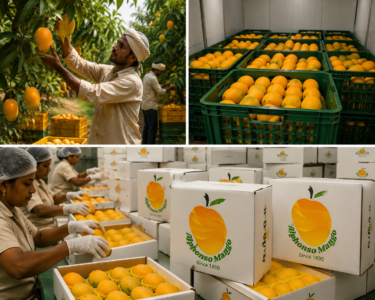
Known as the “King of Mangoes,” the Alphonso (locally referred to as Hapus) holds an unassailable position in global and Indian horticulture. Revered for its rich saffron-colored flesh, non-fibrous texture, and distinct tropical aroma, this coveted fruit commands a significant premium in local fruit markets and export outlets alike.
However, anyone following the summer fruit markets in India knows that the alphonso mango price is far from static. In a single season, wholesale and retail prices can fluctuate wildly—ranging from ₹3,000 to ₹8,000 per dozen in early February down to ₹2000 to ₹3000 per dozen during peak May harvests.
Understanding the dynamics behind the alphonso mango price requires analyzing agricultural economics, changing weather patterns, supply chain dynamics, and consumer demand.
7 Critical Factors That Cause Alphonso Mango Price Fluctuation
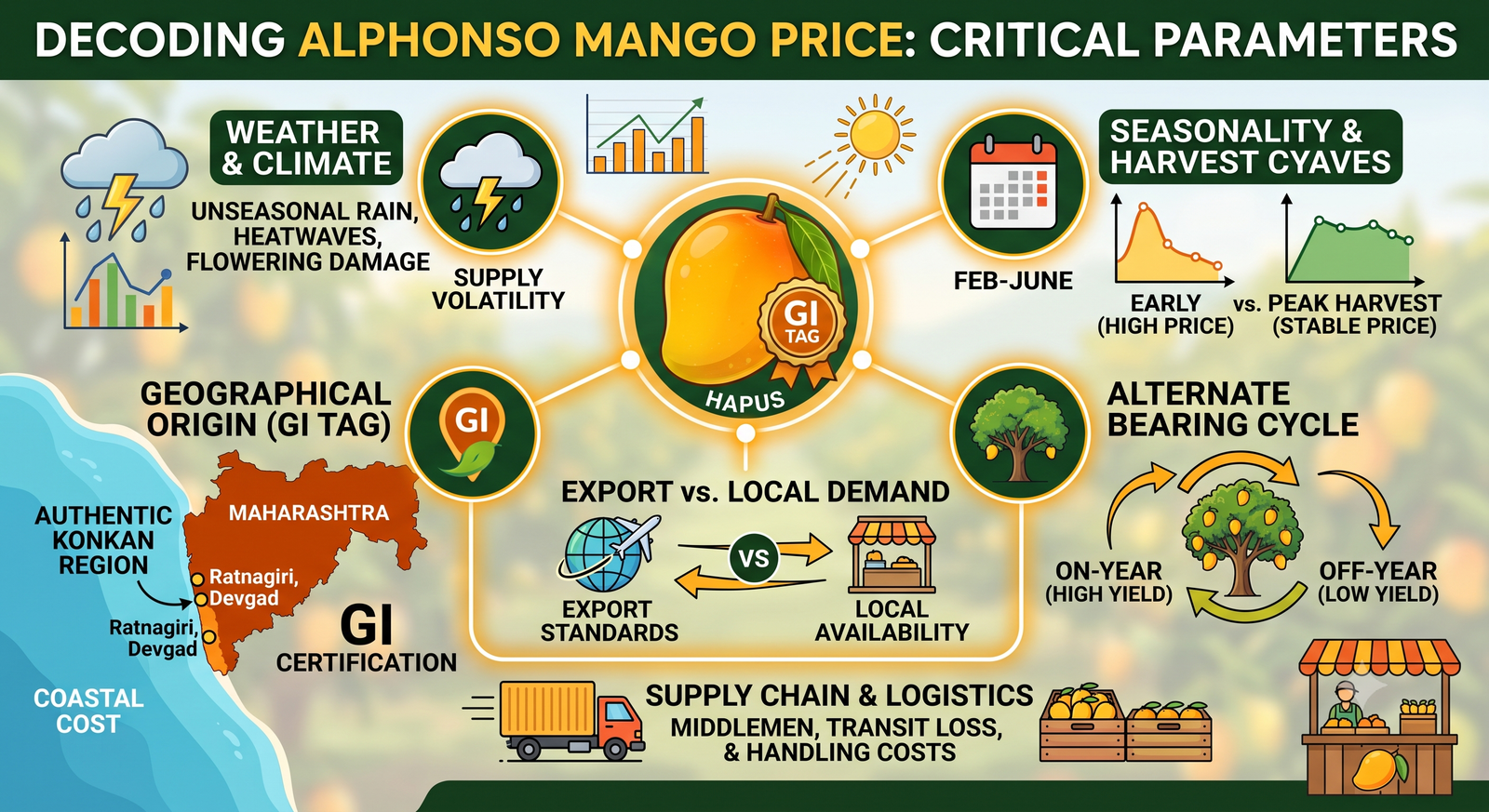
│ ALPHONSO MANGO PRICE DRIVERS │
│
▼ ▼ ▼ ▼ ▼
Weather & Climate Seasonality & GI Tag Export vs. Local Supply Chain & (Rains/Dew) Harvest Cycles
- Weather Anomalies and Climate Change
Mango trees, particularly the delicate Alphonso variety grown in coastal Maharashtra, are extremely sensitive to microclimatic shifts.
- Delayed Flowering: Unseasonal rainfall during late autumn (October–November) delays the tree’s vegetative and flowering stages.
- Panicle Damage: Heavy winter dew or unexpected fog in December and January destroys flowering panicles, causing low fruit set.
- Heatwaves and Unseasonal Rains: Premature heatwaves in February cause young fruitlets to drop, while sudden pre-monsoon hail or rain in April damages unharvested fruit with fungal infections like anthracnose.
When climate conditions wipe out 30% to 60% of early-stage blooms, the reduced supply causes the alphonso mango price to spike exponentially at the start of the season.
- Seasonality and Harvest Waves
The Alphonso harvesting season typically spans from late February through mid-June, operating in distinct supply waves:
- Early Season (Feb – March): Supply is strictly limited to early-blooming orchards in Devgad and Ratnagiri. Driven by high demand from premium buyers and luxury gifting, early-harvest alphonso mango price figures reach peak historical highs.
- Mid-Season / Peak Harvest (April – Mid-May): As temperatures rise, mass harvesting begins across Maharashtra, Gujarat, and Karnataka. Markets experience heavy volume arrivals, leading to price stabilization and seasonal corrections.
- Late Season (Late May – June): Fruit availability drops off rapidly as the monsoon approaches. Remaining quality harvests see modest price increases before the season ends entirely.
- Geographical Origin and GI Tag Certification
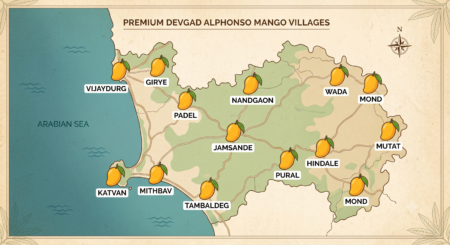
Not every mango labeled “Alphonso” is cultivated equally. In 2018, Alphonso grown in the Konkan belt—comprising Ratnagiri, Sindhudurg (Devgad), Raigad, Thane, and Palghar—received a Geographical Indication (GI) tag.
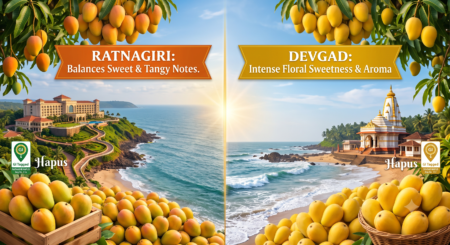
- Ratnagiri & Devgad Hapus: Grown in laterite soil along the Arabian Sea, these coastal fruits possess an ideal sugar-to-acid ratio and a rich aroma. Authentic GI-tagged Konkan Alphonso commands a 40% to 100% price premium over non-GI variants.
- Karnataka & Gujarat Alphonso: Produced in inland soil conditions, these variants yield higher volumes at lower production costs. They sell at lower market prices and are often utilized by commercial processing plants for mango pulp.
- The Alternate Bearing Nature of Mango Trees
Alphonso trees naturally exhibit biennial or alternate bearing behavior. An “On-Year” characterized by high fruit output is typically followed by an “Off-Year” where the tree recovers energy and produces significantly fewer fruits.
During an “Off-Year,” regional yields drop across entire farming belts, keeping the market supply constrained and keeping the alphonso mango price elevated throughout the entire summer.
- International Demand and Export Logistics
India exports thousands of metric tonnes of Alphonso mangoes to the United States, Europe, the Middle East, and Japan every year.
- Phytosanitary & Irradiation Requirements: Export-grade Alphonso fruit must undergo strict sorting, hot-water treatment, or gamma irradiation to comply with international standards.
- Air Freight Rates: Since fresh Alphonso mangoes have a short shelf life, overseas shipments rely on air cargo. Spikes in jet fuel prices or shipping freight costs directly inflate export prices, indirectly altering domestic wholesale allocations.
- Middlemen and Supply Chain Inefficiencies
The traditional supply chain for mangoes in India involves multiple intermediaries:
[Farmer / Orchard] ──> [Village Contractor] ──> [APMC Wholesaler] ──> [Sub-Distributor] ──> [Retailer] ──> [Consumer]
Each step adds handling costs, transit losses, and profit margins. Up to 30% of fresh produce can be lost to spoilage or mechanical damage in transit, driving up the end-consumer alphonso mango price to absorb those supply losses.
- Ripening Method: Carbide vs. Organic Ripening
Naturally ripened Alphonso mangoes are kept in paddy straw stacks over 10 to 14 days, leading to natural moisture loss and storage overheads. Conversely, illicit chemical ripening using calcium carbide forces rapid color change but ruins internal fruit quality. Organic, naturally ripened, and chemical-free certified mangoes carry higher production costs, reflected directly in retail pricing.
10-Year Alphonso Mango Production Trend Analysis (2016–2025)
Understanding historical production metrics provides clearer insight into why the alphonso mango price experiences frequent volatility. While overall national mango output in India has grown steadily, Alphonso production in the core Konkan belt has faced significant climate-induced yield instability.
Production & Price Trajectory Overview
| Year | Primary Production Status (Konkan / Major Belts) | Key Weather / Market Factors |
| 2016 | Normal Yield (~70–75% capacity) | Favorable winter flowering; stable export demand. |
| 2017 | High Yield / “On-Year” (~85% capacity) | Optimal weather; market flooded during April–May. |
| 2018 | Low Yield / “Off-Year” (~40–45% capacity) | Unseasonal rain; GI Tag officially granted to Konkan Hapus. |
| 2019 | Moderate Yield (~60% capacity) | Late winter dew affected first flowering cycle. |
| 2020 | Disrupted Distribution (~65% potential) | COVID-19 lockdowns disrupted transport; farm-gate prices crashed while retail spiked due to logistics. |
| 2021 | Cyclone Tauktae Impact (~35–40% capacity) | Severe May cyclone destroyed standing crops across coastal Maharashtra and Gujarat. |
| 2022 | Severe Heatwave Impact (~30–35% capacity) | Early March heatwave caused massive fruit drop during early development. |
| 2023 | Bumper Crop / “On-Year” (~75–80% capacity) | Mild winter and favorable spring weather led to high yields. |
| 2024 | Moderate Yield (~50–55% capacity) | Heat spikes in April accelerated ripening, creating a short, condensed market window. |
| 2025 | Low Yield / Climate Shock (~25–30% capacity) | Extended monsoon till late November delayed flowering; persistent winter fog damaged panicles. |
Key Takeaways from the 10-Year Trend
- Increased Instability: High climate variability (unseasonal rains, cyclones, heatwaves) has shortened the traditional 3-month harvest window down to concentrated 4-to-6-week bursts.
- Rising Baseline Costs: The minimum baseline alphonso mango price has risen by roughly 60% over the last decade due to rising labor costs, specialized packaging, organic fertilizers, and transportation overhead.
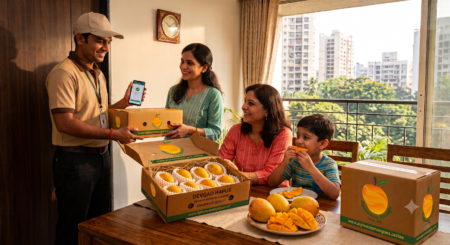
- Shift Toward Direct-to-Consumer (D2C) Models: Due to wholesale price volatility, many Konkan farmers now leverage e-commerce portals to sell directly to consumers, reducing intermediary markups.
How to Get the Best Alphonso Mango Price as a Consumer
If you want to enjoy authentic Hapus without overpaying, keep these smart purchasing strategies in mind:
- Time Your Purchase for Late April to Early May: Buying during the peak harvest phase ensures you get the most competitive alphonso mango price alongside optimal natural sweetness.
- Look for Official GI Tag QR Codes: Ensure you are paying premium rates only for genuine Konkan Alphonso by verifying official GI certification credentials on the crates.
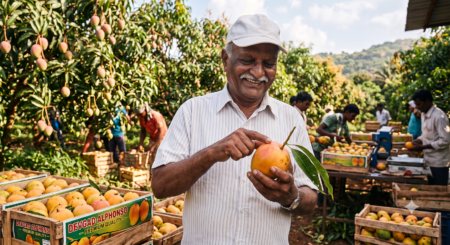
- Buy Direct from Farmers or Verified Farmer-Producer Organizations (FPOs): Eliminating agricultural market intermediaries allows you to secure better prices while ensuring higher returns for the farmers.
- Buy Raw (Unripened) Fruit in Batches: Unripened Alphonso mangoes sell at lower prices than pre-ripened boxes because they remove the retailer’s risk of fruit spoilage. You can ripen them naturally at home in dry grass or hay.